At-Home Strength Training for Women Over 40
No gym required — and no jumping. A chair, a wall, and some floor space cover more than you'd expect. Here's a complete way to train at home, with modification notes for sensitive joints.
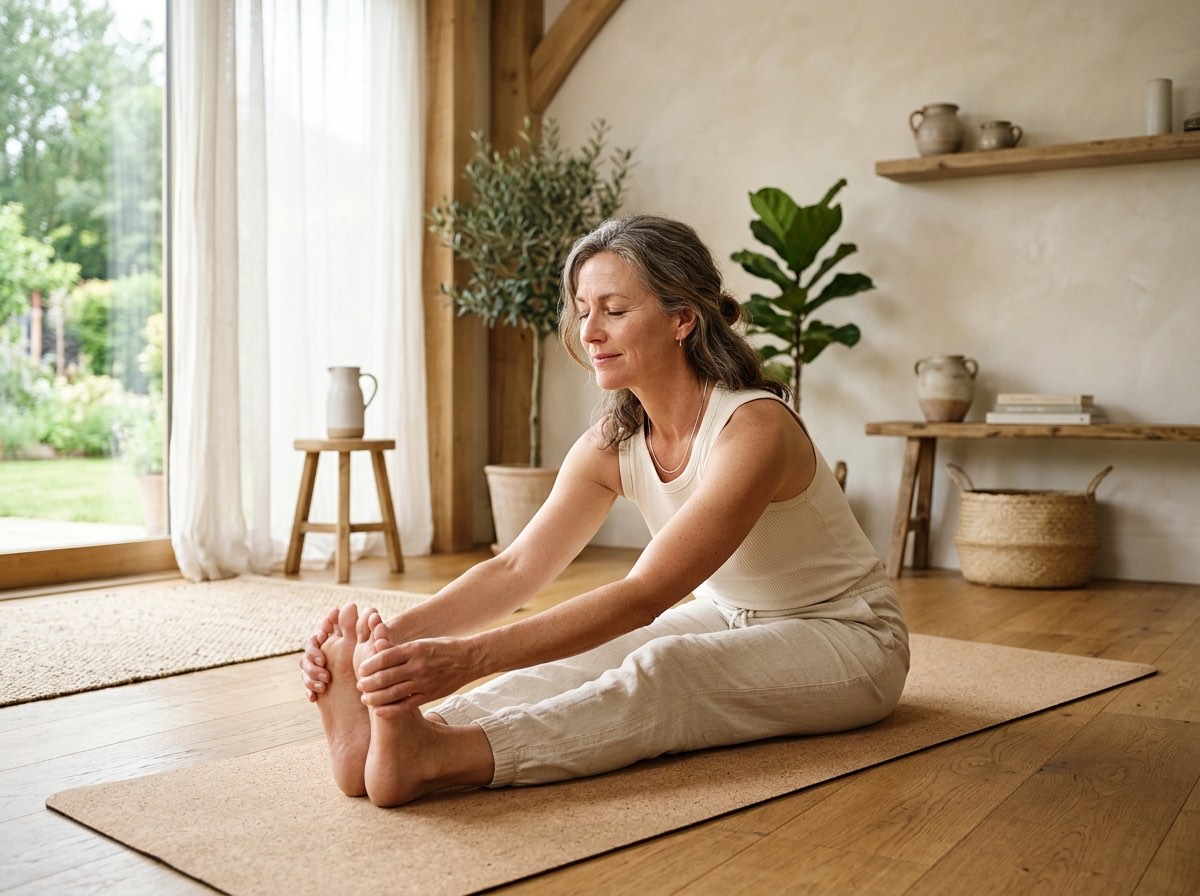
Your House Is a Gym (Really)
Every movement pattern has a household version. Squats become chair squats. Hinges become hip hinges with hands sliding down your thighs, or glute bridges on the floor. Pushes become wall or counter push-ups. Pulls become band rows anchored around a door handle — or towel rows using a sturdy table edge. Carries become grocery bags or water jugs walked around the garden or hallway.
The one honest limitation: eventually, bodyweight progress slows. When it does, a resistance band set (~$10–20) or an adjustable dumbbell pair extends your progression for a long time.
A Complete At-Home Starter Workout
| Exercise | Sets | Reps / Time | Notes |
|---|---|---|---|
| Chair Squat | 3 | 10 slow reps | Sit back gently; stand tall |
| Glute Bridge | 3 | 12 reps | 2-second hold at the top |
| Counter Push-Up | 3 | 8–12 reps | Lower the surface to progress |
| Band or Towel Row | 3 | 10–12 reps | Squeeze shoulder blades; stay tall |
| Grocery-Bag Carry | 3 | 30–40 sec walk | Evenly weighted bags; stand tall |
| Bird Dog | 2 | 8 per side | Slow reaches; level hips |
Rest about 60 seconds between sets. When every exercise feels controlled, slow the lowering phase to 3 seconds before adding equipment.
How to Progress Without Buying Anything (Yet)
- Slow down. A 3-second lowering phase turns an easy exercise into a hard one.
- Add pauses. Pause at the hardest point of the movement for 2 seconds.
- Reduce leverage. Counter push-up → low chair push-up → floor push-up on knees.
- Go unilateral. One-leg glute bridges and split squats double the load on one side with zero equipment.
- Add reps or sets. The simplest lever of all — and perfectly valid for a long while.
Home training's hidden advantage: there is no commute and no opening hours, so consistency — the variable that matters most — is easier to win.
Comfort and Safety Notes
Check your chair and anchors hold weight before you trust them. Keep a slight bend in moving joints rather than snapping into locked positions. And the usual rule applies: sharp or lingering pain means stop, adjust, or ask a professional.
This content is general fitness information, not medical advice, diagnosis, or treatment.