Beginner Strength Training for Women Over 40
A calm, structured way to start lifting: learn five basic movement patterns, train two days a week, and progress only when the last rep feels controlled. Modifications are noted for sensitive joints.
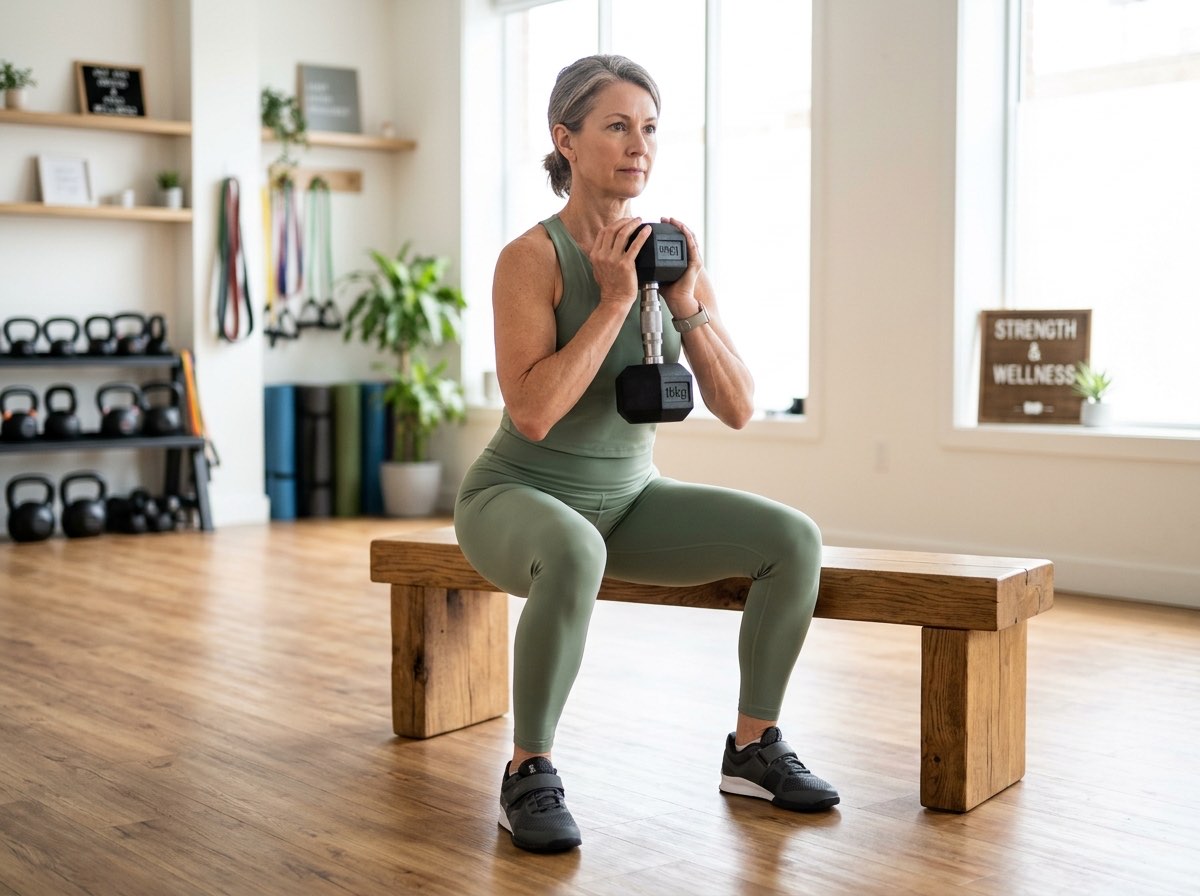
The Five Basic Movement Patterns
Almost every useful strength exercise is a version of one of five patterns. Learn these and you can walk into any gym — or your living room — and build a sensible workout.
- Squat — hips and knees bend together, like sitting down. Examples: chair squat, goblet box squat, wall sit.
- Hinge — bend at the hips with a fairly flat back, like closing a car door with your bottom. Examples: glute bridge, Romanian deadlift.
- Push — press something away. Examples: incline push-up against a counter, wall press.
- Pull — draw something toward you. Examples: band row, dumbbell row.
- Carry — walk with weight. Example: farmer carry with light dumbbells or water jugs.
Your First Two Weeks: A Starter Plan
This is a genuinely beginner-appropriate week. It uses one exercise per pattern per session and deliberately keeps volume low so your body has room to adapt.
| Exercise | Sets | Reps / Time | Notes |
|---|---|---|---|
| Chair Squat | 2 | 10 slow reps | Sit back to a sturdy chair, stand up tall |
| Glute Bridge | 2 | 12 reps | 2-second pause at the top |
| Wall Push-Up | 2 | 8–12 reps | Hands on a wall or counter; the more vertical, the easier |
| Band Row | 2 | 10–12 reps | Light band; squeeze shoulder blades |
| Farmer Carry | 2 | 30 sec walk | Light weights or full water jugs |
| Exercise | Sets | Reps / Time | Notes |
|---|---|---|---|
| Wall Sit | 2 | 20–30 sec hold | Thighs at a comfortable angle |
| Hip Hinge Practice (unweighted) | 2 | 10 slow reps | Hands slide down thighs; flat back |
| Incline Push-Up | 2 | 8–10 reps | Hands on a stable bench or step |
| Band Pull-Apart | 2 | 12 reps | Arms stay fairly straight; squeeze between the shoulders |
| 90/90 Hip Mobility | 1 | 6 transitions per side | Slow, relaxed breathing |
Between sessions: walk, move gently, rest. Rest days are part of the program — muscle adapts between sessions, not during them.
How to Progress
When the top of your rep range feels controlled for two sessions in a row, make the exercise a little harder: add 1–2 kg (2–5 lb), add 2 reps, lower the push-up incline, or slow the lowering phase to three seconds. Change one thing at a time, and only when form is solid.
The most common beginner mistake is doing too much in week one and quitting in week three. The most common success story is boringly consistent sessions, two days a week, for months.
Safety Basics
Muscle burn during a set is normal. Sharp pain, pinching, or pain that lingers after the session is a signal to stop, reduce the load or range, or swap the exercise. If you have a medical condition, a recent injury, or you simply are not sure where to start, a session or two with a qualified trainer or physical therapist is a worthwhile investment.
This content is general fitness information, not medical advice, diagnosis, or treatment.
How many days a week should a beginner strength train?
How long until I notice results?
Should I be sore after every workout?
What weight should I start with?
Three complete dumbbell sessions with weight-selection guidance.
How to train without a gym, and progress without heavy equipment.
Progressive overload, protein, and recovery explained.
Get a personalized weekly schedule in about two minutes.